
Fire Nation Economists Discover New Growth Engine: Imperialism
The Best Way To Get Resources Is To Take Them


Fire Nation Economic Development Council
Office of Strategic Resource Planning
Year 26 of Fire Lord Sozin’s Reign
A Comprehensive Framework for Long-Term Energy Security
The Fire Nation’s rapid industrialization in the past decade has materially improved the quality of life for all citizens. From longer life expectancies to higher inflation-adjusted wages, breakthroughs in steam power and metallurgy have been an engine for economic prosperity.
It is an engine that runs on coal as its fuel source.
Recent forecasts predict complete depletion of all domestic sources of coal in the next decade. Without coal, the economy would grind to a halt.
Any slowdown in economic growth would constitute legal harm to citizens.
To maintain double-digit GDP growth, we must fundamentally reimagine our relationship with the Earth Kingdom, which has the world’s largest coal reserves.
We recommend shifting from a Mercantile (Trade) strategy to a Direct Access (Take) strategy.
Background: Economic Development Trajectory
Avatar Szeto’s bureaucratic reforms centuries ago laid the foundations for the world’s most efficient economy. Efficiency enabled innovation. Innovation enabled industrialization. Industrialization enabled prosperity.
Prosperity created a problem.
Known as a “prosperity trap”, economic growth is now solely dependent on a finite, non-renewable energy source: coal.
We have become a victim of our own success.
Our economic engine is rapidly outpacing its fuel source. It is only a matter of time before coal becomes the limiting factor, instead of driver, for economic growth.
Constrained economic growth is not unfortunate. It is negligence.
Assessing Conventional Options
Additional sources of coal must be secured before the economy is ever affected.
We began a rigorous, months-long process to find solutions for this problem. Using records from the Royal Palace Archives, we initially identified three main ways to get more coal.
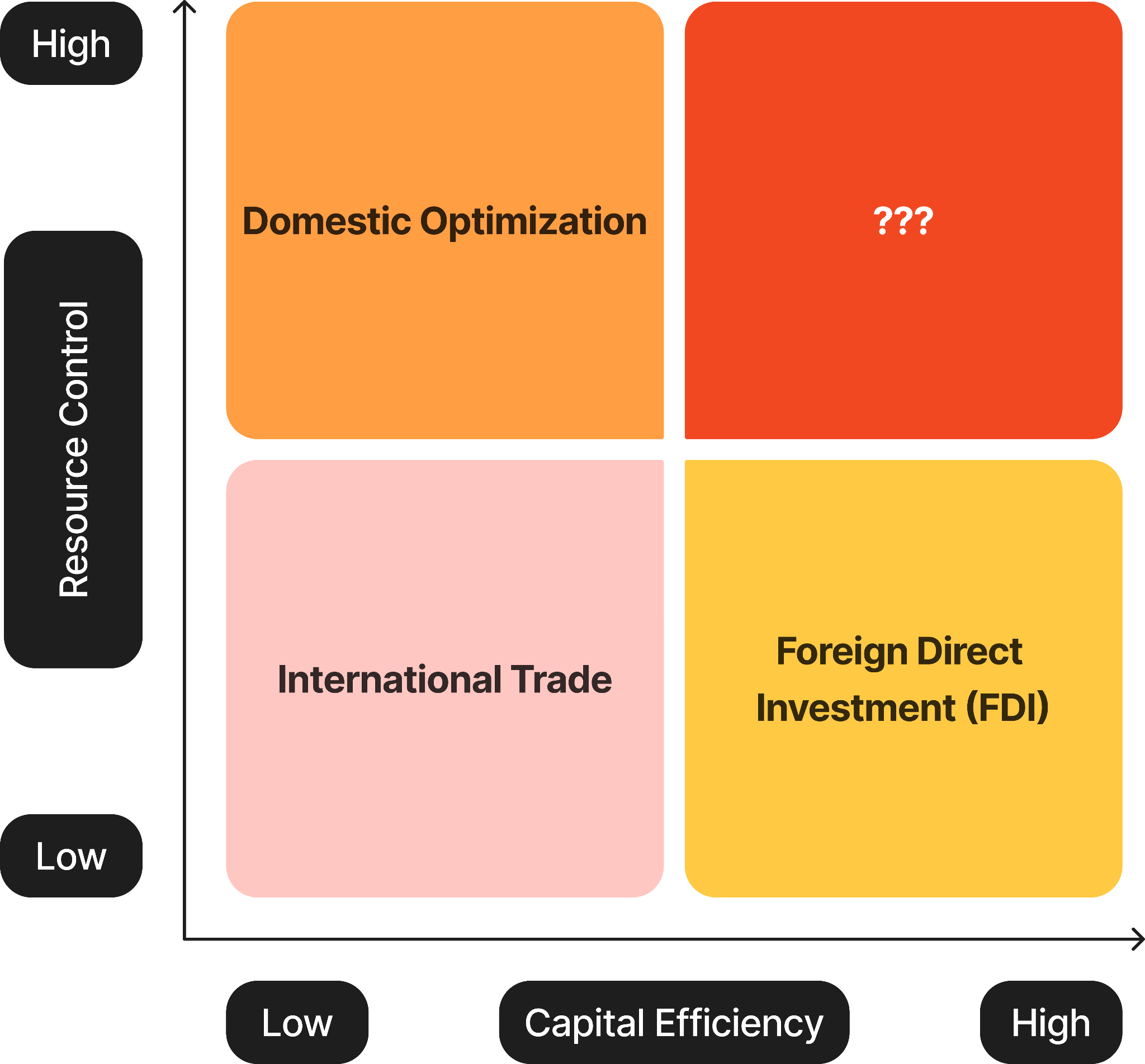
1. Domestic Optimization
Developing better mining equipment and investing in process improvements could improve domestic coal yield through efficiency gains during extraction. We commissioned a comprehensive, Gemba Walk yield improvement study across all 67 active mines and estimated a best-case yield increase of ~2.1% or 3,000 tons of coal.
Unfortunately, coal consumption is expected to grow by 14,000 tons annually so this option would be severely insufficient.
2. International Trade
The Earth Kingdom has the largest known reserves of coal in the world, specifically in the central-eastern region of the Si Wong Desert and other richer veins near Full Moon Bay.
Preliminary RFQs with Ba Sing Se’s largest mining consortiums show untenable margin compression. Even with volume discounts, 30-year fixed contracts for coal would trade at 69 gold/ton, a 460% premium over domestic production costs of 15 gold/ton.
3. Foreign Direct Investment (FDI)
Joint venture partnerships with Earth Kingdom coal companies could be established through existing trade agreements. Exploratory negotiations with major Earth Kingdom mining conglomerates estimate coal production will start in 8-10 years, after a 700M gold CapEx investment to set up infrastructure and train the workforce.
This makes little financial or common sense. We would be transferring technology and expertise to Earth Kingdom companies for at least a decade before seeing any returns.
Individually, these options make no sense. Together, they would simply be the worst, not the best, of all combined options.
We have not even accounted for the political volatility the Earth Kingdom faces through frequent warlord conflicts and subsequent regime instability.
Direct Resource Access: A Non-Traditional Procurement Model
After months of analysis, we faced an uncomfortable reality: every option was feasible but not viable.
Usseewa, an intern, asked a seemingly naive question during a weekly problem solving session: ‘Why does the Earth Kingdom own resources they cannot efficiently utilize?’
That got us thinking.
If ownership is determined by geographical coincidence rather than economic efficiency, isn’t that...anti-capitalist?
We had to go back to the drawing board and take a step back.
Using a bottom-up, top-down and MECE (mutually exclusive, collectively exhaustive) approach, we mapped all coal procurement options across two dimensions: resource control and capital efficiency.
That’s when it hit us.
We were trapped in a legacy mindset.
For months, we worked under the assumptions of established economic theory. For months, we toiled within the rational constraints of how goods and services were exchanged, how things “were always done”.
We could either accept constraints to growth.
Or we could question our constraints.
The Fire Nation has never accepted limits.
What if we just took all the coal from the Earth Kingdom?
Traditional thinking posits that resources belong to whoever occupies the land above them.
We disagree.
Resources belong to whomever can extract the maximum value.
We call this Direct Resource Access.
The Earth Kingdom has proven incapable of managing their coal reserves responsibly. Their coal yields are a fraction of ours. It is economic negligence of the highest order.
The invisible hand of the market doesn’t recognize borders, only efficiency.
The Earth Kingdom is not maximising the economic value from their coal reserves. They leave it underground as a stranded asset.
Direct resource access isn’t an unfair seizure, it is productivity-focused development.
We create value for the Earth Kingdom by investing in their infrastructure.
We serve them by exploiting their resources with our capabilities.
This is comparative advantage in its purest, most elegant form.
By taking their coal, we help the Earth Kingdom.
Economic Growth Through Absolute Resolve
What does direct resource access mean in practice?
It means no coal constraints for the next century of Fire Nation growth.
It means positive externalities for the Earth Kingdom through investment, technology transfer and employment for local populations.
It means resources remain in place while governance changes.
This may seem unconventional.
Yet the numbers are clear and the analysis conclusive.
The Fire Nation must take control of the Earth Kingdom for its coal.
Prepared by:
Solas Khyron, Senior Economist
Office of Strategic Resource Planning


From a purely economic standpoint, the Fire Nation’s actions are simply a resource reallocation strategy. Asking first would’ve slowed GDP growth.
The Earth Nation NEEDS our economic liberation!